Observer's file · opened 2019

Thomas Harvey How early galaxies formed their stars, read from faint smudges on a detector.

I’m a postdoctoral researcher at the Max Planck Institute for Astronomy in Heidelberg. I use JWST, Hubble and Euclid imaging to work out how galaxies in the early Universe formed their stars, and I write the tools that make that inference fast and honest.

HARVEY, T.Q B 8 5 7
Post
Postdoctoral researcher, MPIA, 2026–
Ph.D.
Manchester (Jodrell Bank), 2026
Prev.
Center for Astrophysics, 2021–22
With
Euclid · PEARLS · EPOCHS · Synthesizer
The Andromeda Galaxy
M 31 — Aug. 2019 — 19 × 120 s — Esprit 80ED — T.H. & A. NelTH 0001
Drawer A

Research

click a plate to enlarge it

I study galaxies in the first few billion years of the Universe. I want to know when and how they formed their stars: their star formation histories, the stellar populations they contain, and how much mass they had built. All of that has to be inferred from a galaxy’s light, so much of my work is testing how far the inference can be trusted.

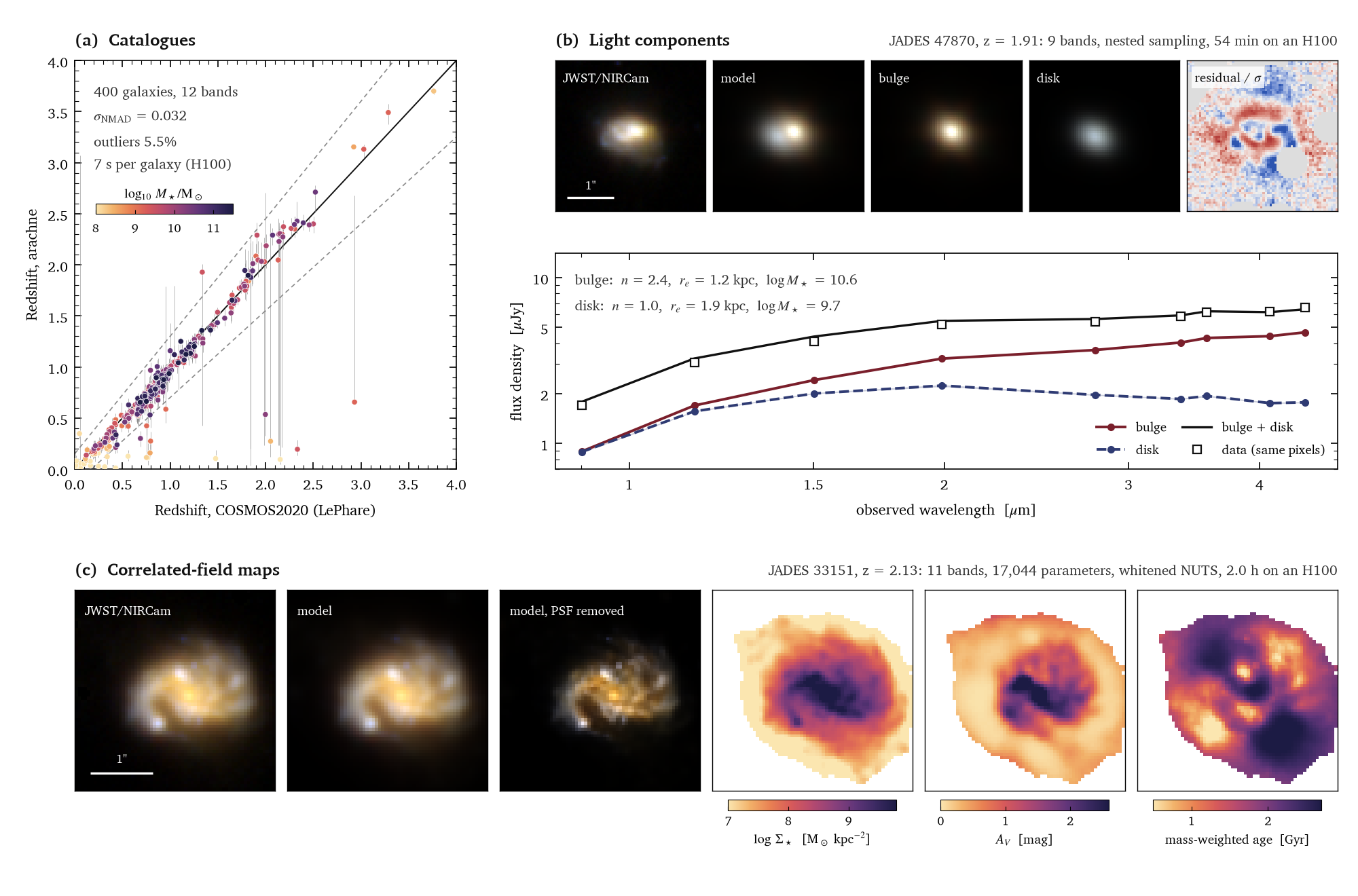
Resolved galaxies. JWST resolves the stellar populations of galaxies at z ≈ 5–10, so we can test whether young starbursts are outshining older stars and hiding mass from integrated fits. I wrote EXPANSE to do this systematically, and I am now building arachne, which forward-models whole multi-band images on a GPU.

more

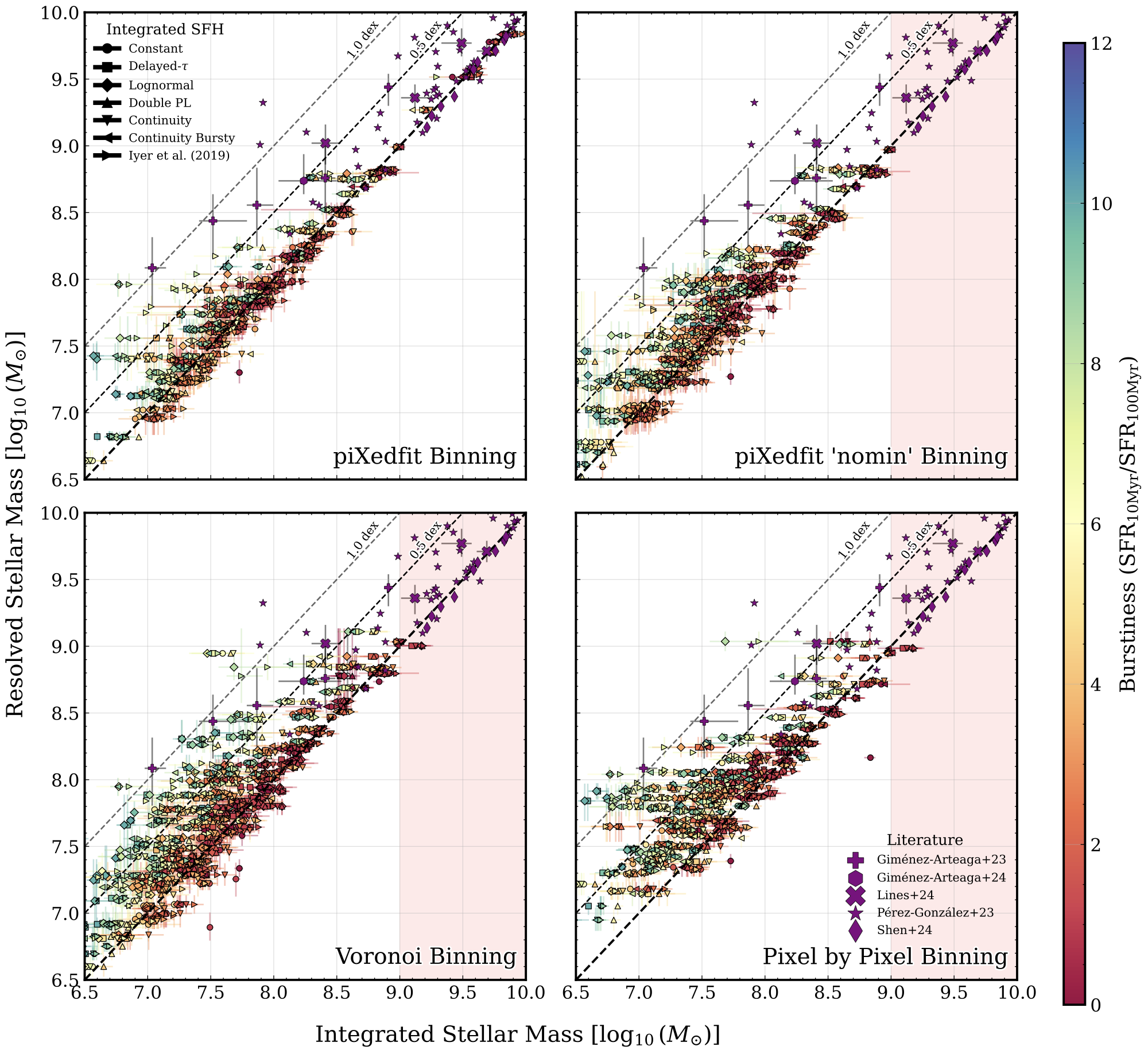
Using 19 NIRCam bands in the JADES Origins Field, I fitted more than 200 galaxies at z ≥ 4.5 pixel by pixel and compared the result with the usual integrated fit. Low-mass, bursty galaxies come out typically 1.25–2.5 times more massive when resolved, and more than ten times in individual cases. Read the paper.

Fast inference. Fitting one galaxy with nested sampling takes minutes to hours, and surveys now contain millions. synference trains a neural posterior estimator on Synthesizer forward models once, then returns a full posterior for a new galaxy in milliseconds.

more

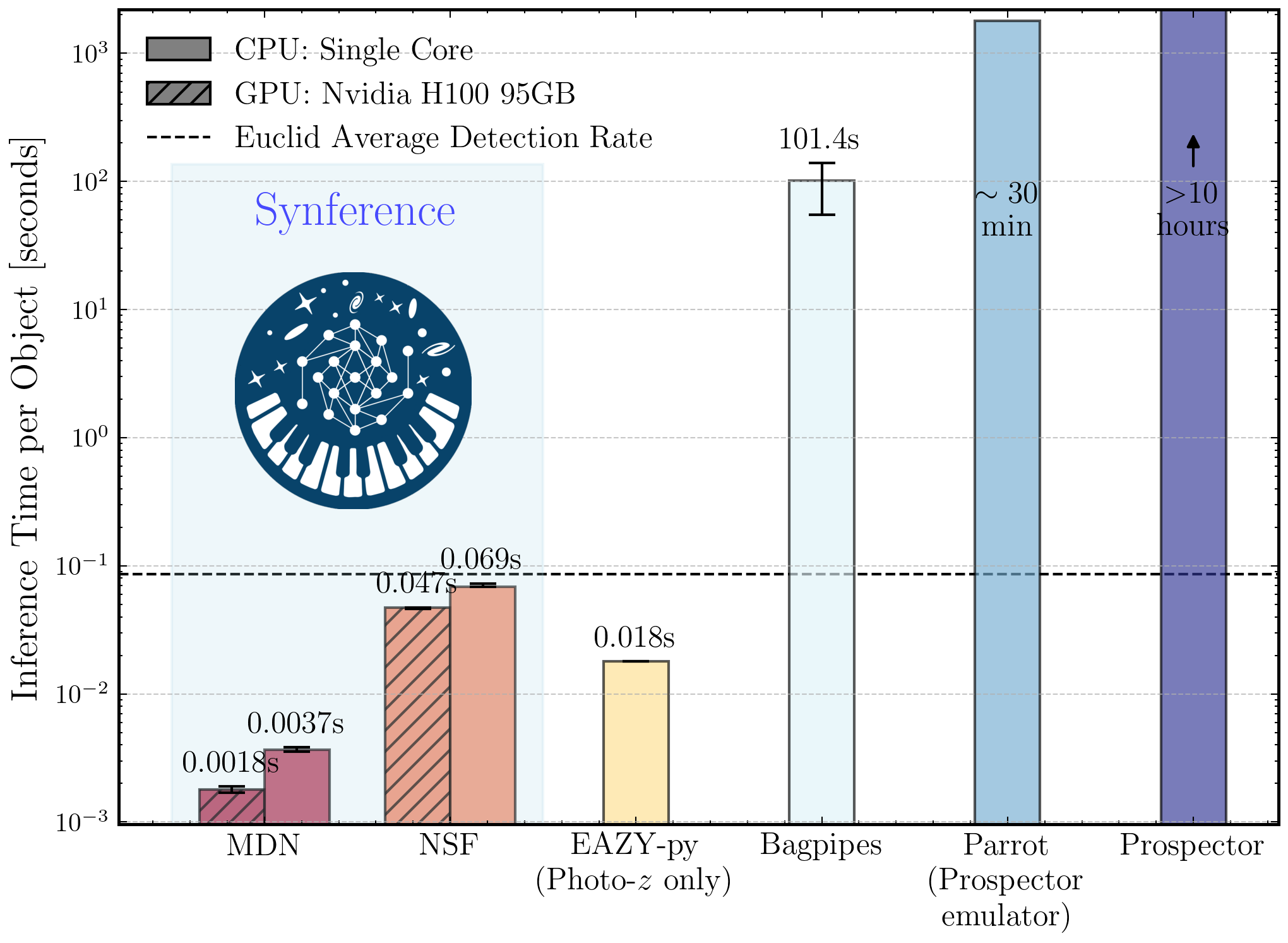
Simulation-based inference combines the speed of machine learning with Bayesian statistics, and speeds up SED fitting by a factor of 10³–10⁵ over conventional sampling. Read the paper.

Euclid Deep Fields. JWST sees very deep but over a tiny patch of sky, so the brightest and rarest early galaxies are mostly missing from its surveys. The Euclid Deep Fields cover about 53 square degrees in the near-infrared, roughly a hundred times the area of the largest JWST survey. I am using them to search for luminous galaxies at z > 7, which mostly means telling real distant galaxies from the cool brown dwarfs that mimic them.

Massive galaxies. At MPIA I work with Anna de Graaff on how the most massive early galaxies formed, as part of the ERC-funded FIRST-GIANTS project.

Black holes and their hosts. My Master’s research at the Harvard-Smithsonian Center for Astrophysics used Chandra and Hubble to study NGC 5972, a galaxy wrapped in gas still glowing from a quasar that has since faded.

more

The extended emission-line region records how the black hole’s output has changed over tens of thousands of years. Read the paper.

GLIMPSE NIRCam image of the galaxy cluster Abell S1063
Abell S1063 — JWST / NIRCam — GLIMPSEJW 0348
Hubble image of NGC 5972
NGC 5972 — HST — fading AGNHS 5972
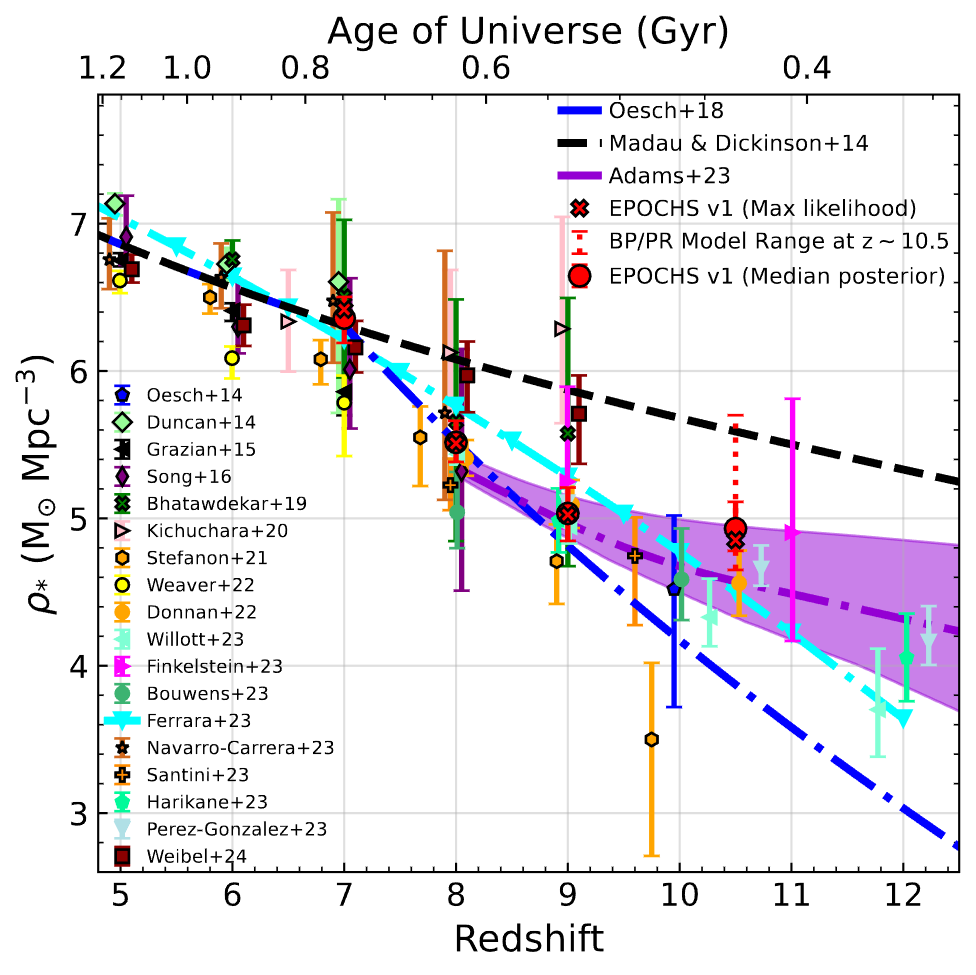
Cosmic stellar mass density versus redshift
Fig. 1. Cosmic stellar mass density at 6.5 < z < 13.5. Harvey et al. 2025, ApJ.
Resolved versus integrated stellar mass for four binning methods
Fig. 2. Stellar mass from resolved fits against the integrated fit, for four ways of binning pixels. Harvey et al. 2025, MNRAS.
Inference time per galaxy for synference and other codes
Fig. 3. Inference time per galaxy: synference against conventional SED-fitting codes. Harvey et al. 2026, MNRAS.
arachne fitting a catalogue, light components and parameter maps
Fig. 4. arachne fitting a catalogue, separate light components, and maps of mass, dust and age.
Drawer B

Publications

click a card for the abstract
TH · 26.02Feb 2026

Flexible Simulation Based Inference for Galaxy Photometric Fitting with Synthesizer

Harvey T., Lovell C.C., Newman S., et al. — MNRAS

journalarXivcodepage

abstract

We introduce Synference, a new, flexible Python framework for galaxy SED fitting using simulation-based inference (SBI). Synference leverages the Synthesizer package for flexible forward-modelling of galaxy SEDs and integrates the LtU-ILI package to ensure best practices in model training and validation. In this work we demonstrate Synference by training a neural posterior estimator on $10^6$ simulated galaxies, based on a flexible 8-parameter physical model, to infer galaxy properties from 14-band HST and JWST photometry. We validate this model, demonstrating excellent parameter recovery (e.g. R$^2>$0.99 for M$_\star$) and accurate posterior calibration against nested sampling results. We apply our trained model to 3,088 spectroscopically-confirmed galaxies in the JADES GOODS-South field. The amortized inference is exceptionally fast, having nearly fixed cost per posterior evaluation and processing the entire sample in $\sim$3 minutes on a single CPU (18 galaxies/CPU/sec), a $\sim$1700$\times$ speedup over traditional nested sampling or MCMC techniques. We demonstrate Synference's ability to simultaneously infer photometric redshifts and physical parameters, and highlight its utility for rapid Bayesian model comparison by demonstrating systematic stellar mass differences between two commonly used stellar population synthesis models. Synference is a powerful, scalable tool poised to maximise the scientific return of next-generation galaxy surveys.

TH · 25.09Sep 2025

Behind the Spotlight: A systematic assessment of outshining using NIRCam medium-bands in the JADES Origins Field

Harvey T., Conselice C.J., Adams N.J., et al. — MNRAS

journalarXivdatapage

abstract

The spatial resolution and sensitivity of JWST's NIRCam instrument has revolutionised our ability to probe the internal structure of early galaxies. By leveraging deep medium-band imaging in the Jades Origins Field, we assemble comprehensive spectral energy distributions (SEDs) using 19 photometric bands for over 200 high-redshift galaxies ($z \geq 4.5$). We present an analysis of this sample with particular emphasis on investigating the "outshining" phenomenon, which can bias the inferred stellar populations by masking the presence of evolved stellar populations ($\geq$ 100 Myr) with the light of bright, young O and B-type stars. We address this problem by performing spatially-resolved SED-fitting of both binned and full pixel-by-pixel photometry, which we compare to the traditional integrated approach. We find evidence for systematic underestimation of stellar mass in low-mass galaxies ($\leq 10^9 \rm M_\odot$) with bursty star formation, which can exceed a factor of 10 in individual cases, but on average is typically a factor of 1.25-2.5, depending on the binning methodology and SFH model used. The observed mass offset correlates with burstiness (SFR$_{10 \ \rm Myr}$/SFR$_{100 \ \rm Myr}$) and sSFR, such that galaxies with recently rising SFHs have larger mass offsets. The integrated SFH models which produce the most consistent stellar masses are the double power-law and non-parametric `continuity' models, although no integrated model fully reproduces all resolved SFHs. We apply an outshining correction factor to the Stellar Mass Function at $z=7$, finding little impact within the uncertainties. We conclude that outshining can be important in individual low-mass galaxies, but the overall impact is limited and should be considered alongside other systematic SED fitting effects.

TH · 25.01Jan 2025

EPOCHS IV: SED Modelling Assumptions and their impact on the Stellar Mass Function at 6.5 < z < 13.5 using PEARLS and public JWST observations

Harvey T., Conselice C.J., Adams N.J., et al. — ApJ

journalarXivdatapage

abstract

We utilize deep JWST NIRCam observations for the first direct constraints on the Galaxy Stellar Mass Function (GSMF) at $z>10$. Our EPOCHS v1 sample includes 1120 galaxy candidates at $6.5<z<13.5$ taken from a consistent reduction and analysis of publicly available deep JWST NIRCam data covering the PEARLS, CEERS, GLASS, JADES GOOD-S, NGDEEP, and SMACS0723 surveys, totalling 187 arcmin$^2$. We investigate the impact of SED fitting methods, assumed star formation histories (SFH), dust laws, and priors on galaxy masses and the resultant GSMF. Whilst our fiducial GSMF agrees with the literature at $z<13.5$, we find that the assumed SFH model has a large impact on the GSMF and stellar mass density (SMD), finding a 0.75~dex increase in the SMD at $z=10.5$ between a flexible non-parametric and standard parametric SFH. Overall, we find a flatter SMD evolution at $z \geq 9$ than some studies predict, suggesting a rapid buildup of stellar mass in the early Universe. We find no incompatibility between our results and those of standard cosmological models, as suggested previously, although the most massive galaxies may require a high star formation efficiency. We find that the "Little Red Dot" galaxies dominate the $z=7$ GSMF at high-masses, necessitating a better understanding of the relative contributions of AGN and stellar emission. We show that assuming a theoretically motivated top-heavy IMF reduces stellar mass by 0.5~dex without affecting fit quality, but our results remain consistent with existing cosmological models with a standard IMF.

TH · 23.10Oct 2023

Signatures of Feedback in the Spectacular Extended Emission Region of NGC 5972

Harvey T., Maksym W.P., Keel W., et al. — MNRAS

journalarXivpage

abstract

We present Chandra X-ray Observatory observations and Space Telescope Imaging Spectrograph spectra of NGC 5972, one of the 19 "Voorwerpjes" galaxies. This galaxy contains an Extended Emission Line Region (EELR) and an arc-second scale nuclear bubble. NGC 5972 is a faded AGN, with EELR luminosity suggesting a 2.1 dex decrease in L$_{\textrm{bol}}$ in the last $\sim5\times10^{4}$ yr. We investigate the role of AGN feedback in exciting the EELR and bubble given the long-term variability and potential accretion state changes. We detect broadband (0.3-8 keV) nuclear X-ray emission coincident with the [OIII] bubble, as well as diffuse soft X-ray emission coincident with the EELR. The soft nuclear (0.5-1.5 keV) emission is spatially extended and the spectra are consistent with two APEC thermal populations ($\sim$0.80,$\sim$0.10 keV). We find a bubble age >2.2 Myr, suggesting formation before the current variability. We find evidence for efficient feedback with L$_{\textrm{kin}}/L_{\textrm{bol}}\sim0.8\%$, which may be overestimated given the recent L$_{\textrm{bol}}$ variation. Kinematics suggest an out-flowing 300 km s$^{-1}$ high-ionization [OIII]-emitting gas which may be the line of sight component of a $\sim$780 km s$^{-1}$ thermal X-ray outflow capable of driving strong shocks that could photoionize the precursor material. We explore possibilities to explain the overall jet, radio lobe and EELR misalignment including evidence for a double SMBH which could support a complex misaligned system.

TH · 26.01Jan 2026

Little red dots as young supermassive black holes in dense ionized cocoons

Rusakov, V. … Harvey, T. et al. — Nature (co-author)

journalarXivpage

abstract

Little red dots as young supermassive black holes in dense ionized cocoons

See also53 works

53 publications in all, 4 as first author

the complete list is rebuilt weekly from arXiv and ORCID

full listORCIDScholar

Drawer C

Software

all public · click a row
InstrumentRoleWhat it does
arachneauthorJAX-native SED fitting and image-level forward modelling: neural emulators of stellar-population models, run on a GPU for catalogues or resolved images.

arachne trains fast neural emulators of stellar-population-synthesis photometry and uses them for GPU-accelerated Bayesian inference: one integrated SED, a catalogue of thousands of galaxies, or a spatially resolved multi-band image with PSF convolution. The pipeline is pure JAX, so it is differentiable end to end. In development.

Repository

synferencelead developerSimulation-based inference for SED fitting, trained on Synthesizer forward models.

A Python framework for SED fitting with simulation-based inference, which combines the speed of machine learning with Bayesian statistics to speed up inference by 10³–10⁵ times compared with conventional sampling. It uses Synthesizer to build realistic forward models, so it can be trained for any combination of stellar population models, star formation histories and instruments.

Repository · Documentation · Paper

EXPANSEauthorResolved SED fitting of galaxy images, binned or pixel by pixel, with an interactive viewer.

A Python package for flexible resolved SED fitting and analysis, including PSF matching, several binning schemes, morphological fitting and an interactive viewer. Available on PyPI as astro-expanse.

Repository · Paper

synthesizercore contributorSynthetic galaxy and AGN observables from simulations and parametric models.

Synthesizer creates synthetic observables (spectra, photometry, imaging and IFU data cubes) from simulations and simple parametric models. It is designed to be fast and flexible. The release paper is published in JOSS.

Repository · Documentation

galfindco-developerAutomated catalogue creation, galaxy selection and SED fitting. With Duncan Austin.

A pipeline that produces catalogues from raw imaging, measures local noise, runs SED fitting with several tools, filters catalogues, and estimates distribution functions such as the UV luminosity function or stellar mass function.

Repository

SkySimauthorFast simulator of realistic mock survey images, with a live web demo.

Generates mock sky images with galaxies, stars and telescope effects, from catalogue generation through to noisy detector images, in seconds on a single CPU. Built on JAX and Synthesizer.

Repository · Live demo

Drawer D

Talks

logbook, recent entries
DateKindTitle and place
2026 Jul 07talkConstraints on the bright-end of the UV LF at z>7 from EDFN and EDFS — Euclid PU SWG Meeting, Ringberg Castle, Kreuth, Germany
2026 Jun 24talkAccelerating SED Fitting for Large Galaxy Surveys with SBI — Simulation Based Inference for Galaxy Evolution 2026 (SBI-GALEV), Cambridge, UK
2026 Jun 23invited talkAn Introduction to SBI: From Simulators to Posteriors — Simulation Based Inference for Galaxy Evolution 2026 (SBI-GALEV), Cambridge, UK
2026 AprtalkSearching for z > 7 galaxies in the Euclid Deep Fields — Euclid:UK Meeting, University of Manchester, Manchester, UK
2026 Marinvited seminarLeveraging SBI for galaxy level inference — University of Bristol, Bristol, UK
2025 Oct 08invited seminarJWST’s view on Star Formation and mass growth in Early Galaxies — Kavli Institute for Cosmology, University of Cambridge, Cambridge, UK

I was invited to visit the department and give a special seminar at the Kavli Institute for Cosmology at the University of Cambridge. The abstract is attached below.

JWST’s view on Star Formation and Mass Growth in early Galaxies

JWST’s NIRCam has transformed our understanding of galaxy structure in the early Universe through unprecedented spatial resolution and sensitivity. Deep wide and medium-band photometry enables precise rest-UV and optical SED constraints, revealing both opportunities and challenges for stellar population modeling.

I will present recent work on the galaxy stellar mass function and total stellar mass density evolution at z > 7, followed by spatially-resolved analysis of 200+ galaxies at z > 5. This reveals how internal structure affects integrated stellar mass estimates through ‘outshining’ effects. I will examine systematic uncertainties in high-redshift SED fitting—including IMF, SPS models, SFH parametrizations, and dust laws—and their impact on derived parameters.

Finally, I will discuss moving beyond traditional SED fitting using machine learning approaches, particularly simulation-based inference (SBI), for large-scale Bayesian inference from wide-area surveys. I will present ongoing work making SBI more accessible for fitting photometry and spectroscopy, enabling rapid constraints on stellar, nebular, and AGN properties in high-redshift galaxies.

Permanent link

Time awarded

Accepted proposals

ProgrammeRoleTitleYear
NOEMA W26FBPIDust, gas, and resolved structure in the most distant galaxy detected by NOEMA2026
NOEMA S26DDPIConfirming the most distant galaxy-galaxy lens: [CII] spectroscopy of a quadruply-imaged galaxy at z ~ 82026
Roman GA 2001Co-IRoman eXtreme Deep Field (RXDF): transformative science at Roman's limit2026
JWST GO 9969Co-IEXTREME: EXploiting TRansients of Extremely Magnified Events2026
JWST GO 11286Co-IThe Euclid–JWST Synergy: Revealing the Nature of Extremely Luminous z ~ 9 Galaxies2026
Drawer E

Plates

my own astrophotography